

 Korrin Wheeler
Simple Steps to Smarter File Access for Nonprofits
 Korrin Wheeler : Apr 16, 2026, 5:41:53 PM
Review who can access your nonprofit’s files and donor data to stay organized, reduce risk, and build a more cyber safe team.

Every development team has felt it lately: the ground shifting under what used to be reliable revenue. A federal grant gets frozen. A longtime foundation funder pivots its priorities. A major donor who gave consistently for a decade suddenly goes quiet. None of this is hypothetical anymore; it's the operating reality for most nonprofits right now.
The instinct after moments like these is to fundraise harder to raise more money for the unstable environment. But more effort aimed in the same direction doesn't fix a structural problem. If your fundraising strategy lives in a silo (disconnected from what finance knows about cash flow and what IT knows about your systems), you're building on a foundation that can't hold under pressure.
Development leaders are often the first to sense trouble: a renewal that doesn't come through, a sponsor pulling back, a shift in how donors are giving. But sensing the problem and having the infrastructure to respond to it are two different things.
A resilient fundraising strategy ultimately relies on factors that extend far beyond the development office, including accurate real-time financial visibility, donor data that remains secure and usable, and seamless compliance that maintains your momentum.
While none of that is fundraising work in the traditional sense, each strategy point determines whether a fundraising strategy actually holds up.
Moving from reactive fundraising to operational stability
The nonprofits weathering funding volatility well aren't the ones with the flashiest campaigns. They're the ones who've diversified their revenue mix deliberately, who present their board with an honest, current picture of cash flow instead of an optimistic one, and who catch a revenue problem months before it becomes a crisis rather than reacting to it in real time.
That kind of resiliency doesn't happen by accident. It happens when development leaders have a standing line of communication with finance and technology; not to slow fundraising down, but to make sure the systems, data, and reporting behind it can actually support the strategy being built on top of it.
We’ve partnered with our friends over at Carey & Co, an outsourced leadership firm serving nonprofits exclusively since 2013, to host an educational webinar, Fundraising Resiliency: Protecting Your Nonprofit's Revenue. 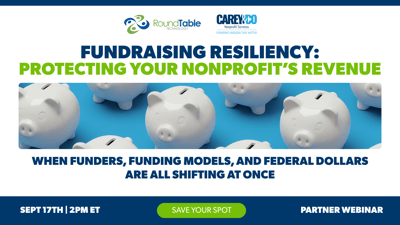
This free educational webinar will cover practical ways to keep programs funded through unexpected shifts, how to present cash flow data your board will actually trust, and simple steps to catch revenue problems early. Creating a funding strategy that can withstand financial chaos starts with learning how and what to look for.

Schedule a brief chat to learn how a customized technology roadmap can change the landscape of your entire organization!
 Korrin Wheeler : Apr 16, 2026, 5:41:53 PM
Review who can access your nonprofit’s files and donor data to stay organized, reduce risk, and build a more cyber safe team.
 Korrin Wheeler : Mar 26, 2026, 12:26:54 PM
Evaluate your nonprofit's software with confidence! Learn what to review before adopting a new platform, from integrations to compliance.
 Korrin Wheeler : Apr 23, 2026, 11:48:06 AM
Learn simple cybersecurity habits small nonprofits can adopt to reduce risk, protect data, and strengthen operations without breaking the bank.